
What Is Incentive Abuse Prevention?


Tags: Incentives & Rebates
More importantly, how can you protect your incentive programs?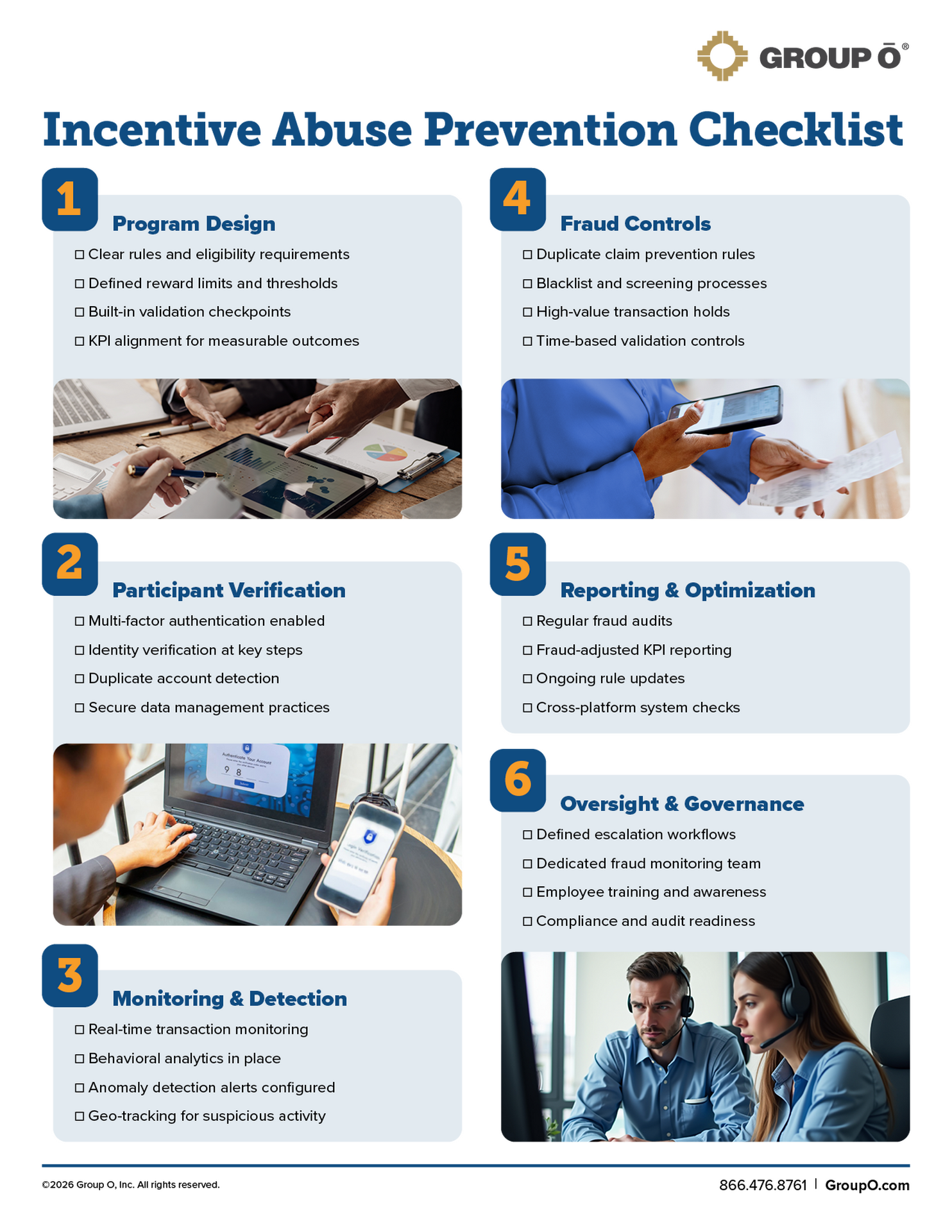
Incentive programs are designed to influence behavior, drive loyalty, and improve performance. But as programs become more sophisticated and widely adopted, they also become more vulnerable to abuse.
From duplicate rebate claims to account manipulation and reward misuse, incentive abuse can quietly erode ROI, distort data, and damage participant trust.
The question is no longer if abuse will happen, it’s how prepared your program is to prevent it.
What Is Incentive Abuse?
Incentive abuse refers to any behavior - intentional or opportunistic - that exploits the rules, structure, or technology of a program to gain unearned rewards.
This includes both fraudulent actions and policy loophole exploitation, such as:
• Creating multiple accounts to claim sign-up or referral rewards
• Submitting duplicate or manipulated rebate claims
• Exploiting promotion rules or timing gaps
• Unauthorized reward redemptions or account takeovers
• Employee misuse of program access or data
As seen across loyalty and incentive ecosystems, these activities can range from minor misuse to highly organized, technology-driven fraud.
Industry leaders highlight that modern incentive fraud has evolved into automated, scalable attacks, often targeting high-value programs and digital reward ecosystems.
Why Incentive Abuse Matters
At first glance, incentive abuse may seem like a small operational issue. In reality, it impacts every part of your program:
1. Erodes ROI: Fraudulent claims and duplicate rewards reduce the true return on investment and inflate program costs.
2. Distorts Performance Data: As explored in our North-Star Metrics article, programs rely on clean data to measure success. Abuse introduces noise that can mislead decision-making.
3. Damages Trust: Participants expect fairness. When abuse goes unchecked, it undermines confidence in the program and the brand behind it.
4. Creates Compliance and Audit Risk: Incentive programs must balance engagement with governance and transparency.
Download your copy of the Incentive Abuse Prevention Checklist by clicking on the image of it. It will open in a new window for you to download!
How Incentive Abuse Happens
Across your internal content and industry sources, incentive abuse tends to fall into three core categories:
| 1. Internal Abuse • Employees or partners manipulating accounts • Unauthorized reward issuance • Misuse of administrative access | 2. External Fraud • Fake identities and account creation • Bot-driven attacks on promotions or reward systems • Account takeover and points theft | 3. Program Design Exploitation • Gaming unclear rules or loopholes • Exploiting referral bonuses or coupon stacking • Taking advantage of timing gaps |
Program vulnerabilities often stem from fragmented systems, inconsistent validation, and lack of oversight.
How to Prevent Incentive Abuse
Effective incentive abuse prevention requires more than a single tool. It’s a system of controls, design decisions, and ongoing monitoring aligned with the full lifecycle of the program.
1. Build Prevention Into Program Design • Define clear eligibility rules and limits | 2. Strengthen Verification and Access Controls • Multi-factor authentication (MFA) | 3. Implement Real-Time Monitoring and Detection • Transaction monitoring for anomalies |
4. Apply Fraud Prevention Rules and Controls • Duplicate claim detection | 5. Continuously Audit and Optimize • Regular program audits and reporting | 6. Combine Technology with Human Oversight • Escalation workflows for flagged activity |
The Bigger Picture: Incentive Programs as Infrastructure
One of the biggest themes in our 2026 Incentive Strategy Roadmap is the shift from campaigns to systems.
Incentive programs are no longer one-time promotions, they are ongoing engagement infrastructure that must:
• Scale efficiently
• Deliver measurable ROI
• Maintain participant trust
• Withstand fraud and abuse
Abuse prevention is not a standalone feature. It is a core capability of modern incentive strategy.
Incentive Abuse is Inevitable. But Its Impact is Not.
Organizations that take a proactive, system-level approach to incentive abuse prevention can:
• Protect budgets and profitability
• Preserve clean, reliable data
• Build trust with participants
• Strengthen long-term program performance
The result is not just a safer program, it’s a more effective one. Check the next section for examples of incentive abuse and how Group O helped mitigate it.
Incentive Abuse Example 1: The “Too Many Rebates” Problem
A consumer submits a rebate claim after purchasing a product and everything looks valid. A few days later, another claim comes in for the same promotion. Then another.
At first glance, nothing seems out of place. Each submission uses slightly different details. Maybe an abbreviated name. A different email. A variation in the address. Individually, they pass validation.
But when you zoom out, it tells a different story. One purchase. Multiple payouts.
This kind of abuse is easy to miss when programs rely on manual review or disconnected systems. It doesn’t look like fraud, it looks like participation.
Group O Solution
Group O connects the dots behind the scenes.
Instead of reviewing each claim in isolation, we analyze data across the entire program to identify patterns that don’t add up. Our systems:
• Match submissions across variations in names, emails, and addresses
• Standardize and compare purchase documentation using IDP
• Flag duplicate or suspicious claims in real time
• Apply intelligent rules to stop repeat payouts before they happen
The result is simple: rewards go to the right participant, once.
Incentive Abuse Example 2: Fast Payments, Faster Exploitation
A company launches a promotion with instant digital payouts. The goal is a better participant experience—fast, seamless, and convenient.
And it works… at first.
Then the data starts to shift. A handful of participants begin showing up over and over again. Same behavior. Same offer. Different email addresses each time.
What looked like strong engagement is actually someone exploiting the system triggering multiple payouts before anyone has time to catch it.
Group O Solution
Group O helps brands deliver speed without losing control.
We build safeguards directly into the payout process so rewards can move quickly but not blindly. That includes:
• Identity verification at key moments in the journey
• Eligibility validation before any payout is released
• Controls that limit rapid, repeat participation
• Real-time monitoring that flags unusual activity immediately
So yes, participants still get fast rewards. But only when they’ve truly earned them.
Incentive Abuse Example 3: When Access Becomes Risk
An incentive program is running smoothly. Claims are being processed. Rewards are going out. Nothing raises concern—until reporting starts to look off.
A deeper review reveals something unexpected. Rewards were issued that don’t tie back to real participants. Accounts were created that shouldn’t exist.
The issue didn’t come from outside the program. It came from inside—someone with access using the system in ways it wasn’t intended.
Group O Solution
Group O treats internal risk just as seriously as external threats.
We create clear guardrails around who can do what within the system, including:
• Role-based permissions that limit access to sensitive actions
• Full audit trails that track every change and transaction
• Approval workflows for high-value or manual reward issuance
• Segmentation of duties to prevent single-user control
Every action is visible. Every reward is accountable.
Incentive Abuse Example 4: When “Engagement” Isn’t Real
A referral campaign launches and participation takes off. Sign-ups spike. Activity increases. On paper, it looks like a major success.
But something feels off.
The same patterns start repeating: similar emails, repeated referral loops, and accounts that don’t engage beyond the initial reward. What looks like growth is actually the same individuals recycling the system to earn more incentives.
It’s not fraud in the traditional sense, it’s gaming the rules.
Group O Solution
Group O helps brands design programs that reward real behavior not artificial activity.
We look at both structure and behavior to identify and prevent these patterns:
• Unique participant identification to link related accounts
• Referral validation rules that prevent self-rewarding loops
• Behavioral analysis to detect repeat or abnormal activity
• Continuous rule updates to close gaps as they appear
Because true program success isn’t just about participation numbers it’s about meaningful engagement.
Incentive abuse doesn’t always look like fraud. Sometimes, it looks like your best-performing campaign. The difference is visibility and the systems behind it.
 About the Author
Ashley Cramer is a Customer Success Manager at Group O with over eight years of experience supporting incentive, rebate, and reward programs. Working closely with clients and participants every day, she plays a key role in identifying patterns of misuse, resolving edge cases, and ensuring programs operate as intended. Ashley brings a practical, on-the-ground perspective to incentive abuse prevention balancing participant experience with the controls needed to protect program integrity and ROI.

 About the Author
Ashley Rowatt is a Customer Success Director at Group O with a decade of experience leading incentive marketing programs. She partners with clients to design and manage scalable programs that deliver measurable results while minimizing risk. With deep expertise in program governance, fraud detection, and operational oversight, Ashley helps organizations proactively address abuse and close gaps before they impact performance. Her leadership ensures incentive strategies remain both effective and secure.