
Risk, Compliance & Ethics in Incentives


Tags: 2026 Incentive Marketing Series, Incentives & Rebates
2026 Incentive Strategy Roadmap — Mile 7
About the 2026 Incentive Strategy Roadmap
The 2026 Incentive Strategy Roadmap is a multi-part series from Group O designed to help brands build incentive programs that are relevant, scalable, and defensible in a rapidly changing environment. Each mile focuses on a critical component of modern incentive strategy, from measurement and personalization to fulfillment, participant experience, and long-term program performance. Together, the series provides a practical framework for organizations that need incentive programs to perform reliably while meeting rising participant expectations.
The Road So Far
Throughout the first six miles of this series, one theme has remained consistent: incentive programs are no longer viewed as isolated marketing tactics. They have become part of the broader participant experience.
We began by establishing the innovation baseline for incentives in 2026 and explored how changing participant expectations are redefining program design. We examined the importance of North Star Metrics, modernization of rebates, first-party data strategies, disbursement choice, and the growing role participant experience plays in long-term engagement. Across every topic, the underlying goal has remained the same: create programs that participants trust, value, and want to engage with repeatedly.
As programs become more sophisticated and data-driven, another critical consideration rises to the forefront: risk, compliance, and ethics.
Why Risk, Compliance & Ethics Matter More Than Ever in 2026
Many organizations still view compliance as something that happens behind the scenes. In reality, participants experience compliance every day.
They experience it when program terms are clear. They experience it when rewards are delivered as promised. They experience it when their personal information is protected. They experience it when promotions feel fair and transparent rather than confusing or misleading.
In today's environment, trust is one of the most valuable assets an incentive program can build. Unfortunately, it can also be one of the easiest things to lose.
The incentive landscape continues to evolve alongside changing privacy regulations, digital payment technologies, fraud threats, disclosure requirements, and participant expectations around transparency. At the same time, loyalty and incentive programs are increasingly collecting more data, operating across more channels, and engaging participants through more personalized experiences than ever before.
As complexity increases, risk follows.
The organizations that will lead in 2026 are not necessarily the ones running the biggest programs. They are the ones building programs participants trust.
Compliance is no longer simply about avoiding penalties. Ethics is no longer simply about checking a box. Both have become strategic advantages that directly influence participant engagement, brand reputation, and long-term program performance.
Regulatory Considerations in Incentive Programs
No two incentive programs are exactly alike, but every program operates within a framework of rules, disclosures, and requirements.
Depending on program structure, organizations may need to consider:
• Sweepstakes and promotional regulations
• Reward and payment compliance requirements
• Consumer protection rules
• Data privacy requirements
• Tax reporting obligations
• Industry-specific regulations
• Advertising and disclosure standards
One of the most common mistakes organizations make is focusing exclusively on the reward while overlooking the operational processes surrounding it.
Consider a simple promotional campaign offering participants a chance to earn rewards through referrals, purchases, or engagement activities. The reward itself may be attractive, but if eligibility requirements are unclear, disclosures are difficult to find, or fulfillment timelines are inconsistent, participant confidence begins to erode.
The Federal Trade Commission continues to emphasize transparency, accurate representations, and clear disclosure of material relationships and program terms. Organizations must ensure participants understand how programs work, how rewards are earned, and what conditions apply.
From a program management perspective, compliance should be integrated into planning from the beginning rather than layered on after launch.
The most effective organizations evaluate risk, legal requirements, participant communications, technology platforms, fulfillment processes, and reporting mechanisms during program design.
When compliance becomes part of the program architecture, it becomes significantly easier to scale.
Ethical Program Design & Disclosure
Compliance tells us what we must do.
Ethics helps determine what we should do.
Being an effective Incentive Marketer means ALWAYS doing what’s good for our clients, good for their customers and legally required by our industry!
Participants today are increasingly sophisticated. They understand how loyalty programs operate. They recognize when communications are transparent and when they are not. They see through the smoke and mirrors and will call out a brand on not being consistent or failing to follow through on promised value. Even if this is simply a perception, it can be damaging to an Incentive Marketer’s reputation and credibility. Most importantly, they remember experiences that feel fair and respectful.
Ethical program design starts with transparency.
Participants should never have to search for critical information. Program rules, eligibility requirements, reward values, expiration timelines, and redemption conditions should be clearly communicated and easy to understand.
This is especially important as organizations invest more heavily in personalization and first-party data strategies.
Participants are generally willing to share information when they understand the value exchange. Problems typically occur when expectations are unclear or when data practices seem inconsistent with program promises.
Ethical program design also means avoiding unnecessary friction.
Complicated redemption processes, confusing qualification criteria, hidden restrictions, and inconsistent communications can damage trust even when a program remains technically compliant.
The strongest programs create alignment between what participants expect and what they actually experience.
When trust increases, engagement tends to increase as well.
This theme continues to emerge throughout loyalty and engagement research, where transparency, relevance, and customer trust remain critical factors in long-term program success.
And please don’t forget OUR responsibility in all this as Incentive Marketers. Design and execution along with managing the perceptions of participants and the outcomes of the programs falls squarely on each of us serving brands that entrust their promotional business to us. We of course need to consider the savviness of participants, but also the inexperience and unfamiliarity with the various components of these programs for our clients that can drive negative sentiments, poor customer experiences, reduced loyalty and even regulatory pitfalls and penalties if we don’t provide appropriate and ongoing guidance and expertise to their programs.
It is paramount for us to uphold the integrity of Incentive Marketing in every vertical that we touch, and ensure the impacts are not only what our clients intend for us to have but also fit within the framework of legal and ethical standards that we are all held to in this industry. Clients need to trust us as much as their participants trust them, and ultimately, WE own both ends of these interdependent relationships. The burden is ours to bear because the benefits of managing these programs come from not only doing them well but doing them RIGHT!
Managing Risk While Maintaining Participant Trust
Risk management is often associated with preventing fraud or limiting financial exposure.
Those are certainly important considerations. However, in incentive programs, some of the greatest risks are actually trust risks.
Examples include: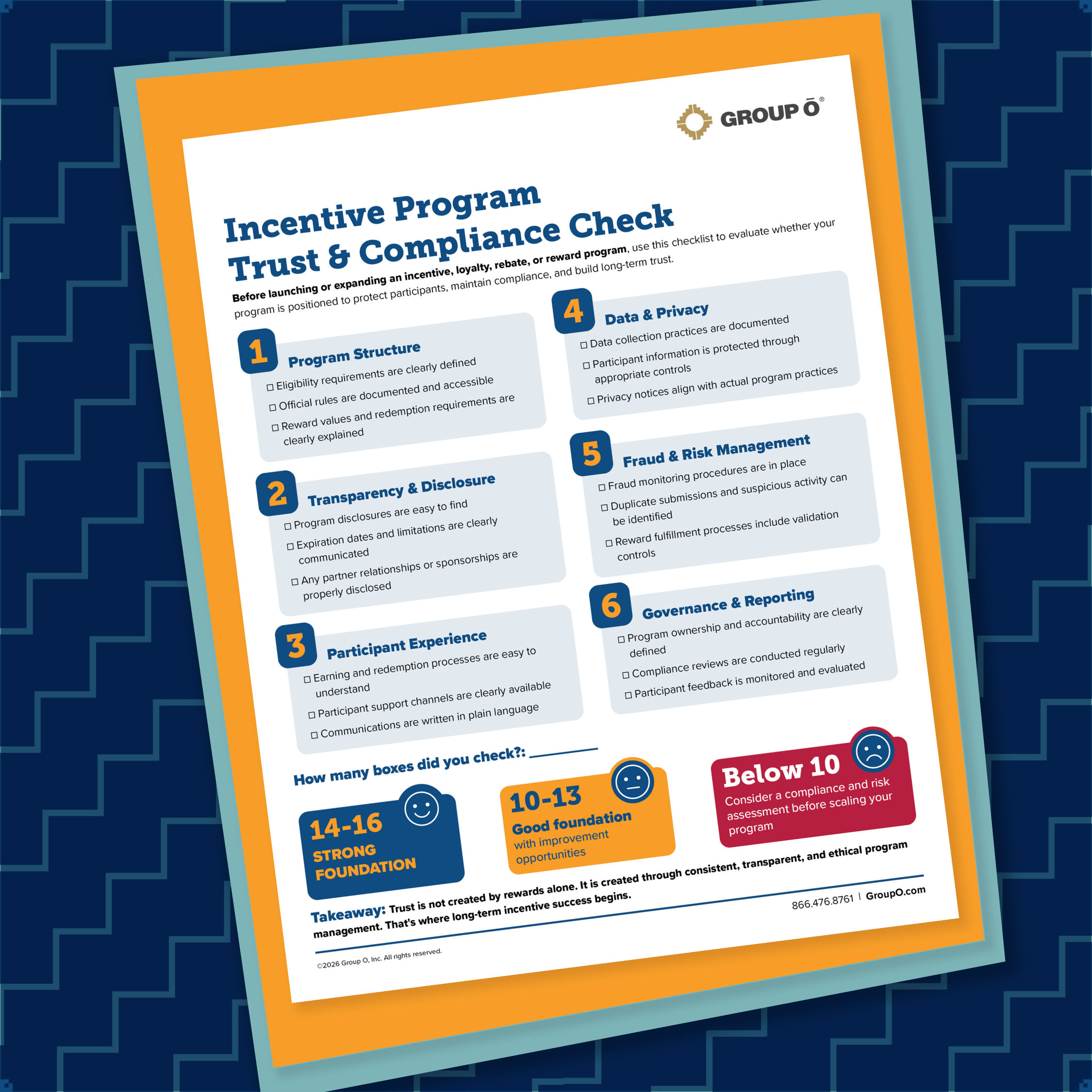
• Program Integrity Risks
• Fraudulent claims
• Duplicate submissions
• Account takeovers
• Abuse of referral systems
• Reward theft
• Operational Risks
• Delayed fulfillment
• Payment failures
• Technology disruptions
• Data inaccuracies
• Reputation Risks
• Misleading communications
• Confusing program terms
• Inconsistent participant experiences
• Perceived unfairness
Again, we as Incentive Marketers are most accountable to these. There is no quicker way to lose business and subsequently credibility in this industry if you can’t successfully navigate these areas of risk and deliver solutions that earn immediate trust from clients and participants.
Download our free 10-Point Incentive Program Trust & Compliance Checklist by clicking on the checklist image.
A Note on Compliance: Every incentive program is unique. While this checklist can help identify common areas of risk and review, it should not be considered legal advice. Organizations should work with their legal and compliance teams to evaluate program requirements before launch.
Organizations cannot eliminate every risk. What they can do is build systems designed to identify, mitigate, and manage those risks proactively.
At Group O, fraud prevention, reward validation, participant support, payment security, and fulfillment oversight are viewed as foundational components of successful incentive programs rather than afterthoughts. Effective risk management protects more than budgets, it protects participant confidence.
The goal is not to create more barriers.
The goal is to create confidence.
Participants should feel secure that rewards are earned fairly, delivered accurately, and supported by transparent program operations.
When organizations successfully balance security with participant experience, risk management becomes a trust-building strategy rather than merely a compliance function.
Key Terms for This Article
Compliance: The process of ensuring incentive programs operate within applicable laws, regulations, and industry standards.
Disclosure: The clear communication of rules, requirements, relationships, limitations, and conditions that may influence participant decisions.
Participant Trust: The confidence participants have that a program is fair, transparent, secure, and operating as promised.
Data Privacy: The practices used to collect, store, manage, and protect participant information.
Fraud Prevention: Processes and technologies used to detect, prevent, and mitigate unauthorized or deceptive activity within incentive programs.
Program Governance: The framework of policies, oversight, controls, and accountability used to manage program performance and risk.
Ethical Design: Creating participant experiences that prioritize fairness, transparency, accuracy, and respect for participant expectations.
Data Points & Market Insights
Transparency Is Increasingly Important: The FTC's advertising and endorsement guidance continues to emphasize clear disclosure of material relationships, truthful representations, and transparency in promotional practices. Organizations must provide participants with clear information that influences decision making. [ftc.gov], [ftc.gov], [ecfr.gov]
Incentive Marketing Remains a Major Industry: The Incentive Marketing Association represents organizations operating within an incentive industry estimated at approximately $90 billion, highlighting both the scale and significance of incentive programs in modern business strategy.
Ethics Extends Beyond Compliance: Industry associations such as the Incentive Marketing Association maintain formal codes of conduct, privacy standards, and governance policies, reflecting the growing importance of ethical management practices within incentive and recognition programs.
Trust and Personalization Must Coexist: Recent loyalty research continues to identify transparency, data privacy, and trust as critical considerations as organizations expand personalization efforts and first-party data strategies.
Participant Expectations Continue to Rise: Research across loyalty and customer engagement programs shows participants increasingly expect seamless experiences, relevant interactions, transparency, and control over their engagement journey.
Prioritize Compliance, Ethics, and Risk Management
As incentive programs become more sophisticated, compliance, ethics, and risk management can no longer be treated as back-office functions.
They are foundational elements of participant experience.
The organizations that thrive in 2026 will be those that view trust as a strategic asset. They will build incentive programs that are transparent, secure, ethically designed, and operationally sound from day one.
At Group O, we help organizations navigate the complex intersection of participant engagement, reward fulfillment, fraud prevention, compliance, and program management. Because the most successful incentive programs are not simply the ones that drive action today, they are the ones participants trust tomorrow.
 About the Author
Paul Flemr is Senior Vice President of Incentive Marketing Solutions at Group O, bringing more than 17 years of leadership experience across operations, customer care, and incentive marketing. Throughout his career at Group O, Paul has held progressive roles spanning Customer Care, Operations, and Executive Leadership, giving him a uniquely end‑to‑end perspective on building and delivering high‑impact incentive programs. Known for his passion for concierge‑level client service, Paul is deeply committed to ensuring incentive marketing clients receive seamless, white‑glove support—from strategy and program design through execution and fulfillment. He is a strong advocate for embracing new technology and innovative ideas to continuously elevate program performance and the client experience. As an author for The 2026 Incentive Strategy Roadmap, Paul brings practical insight, operational expertise, and a forward‑looking mindset to help organizations design incentive programs that drive engagement, loyalty, and measurable results.
