
Overcoming AI Adoption Hurdles in Supply Chain Operations


Tags: Supply Chain
(AND HOW BPO PARTNERS HELP)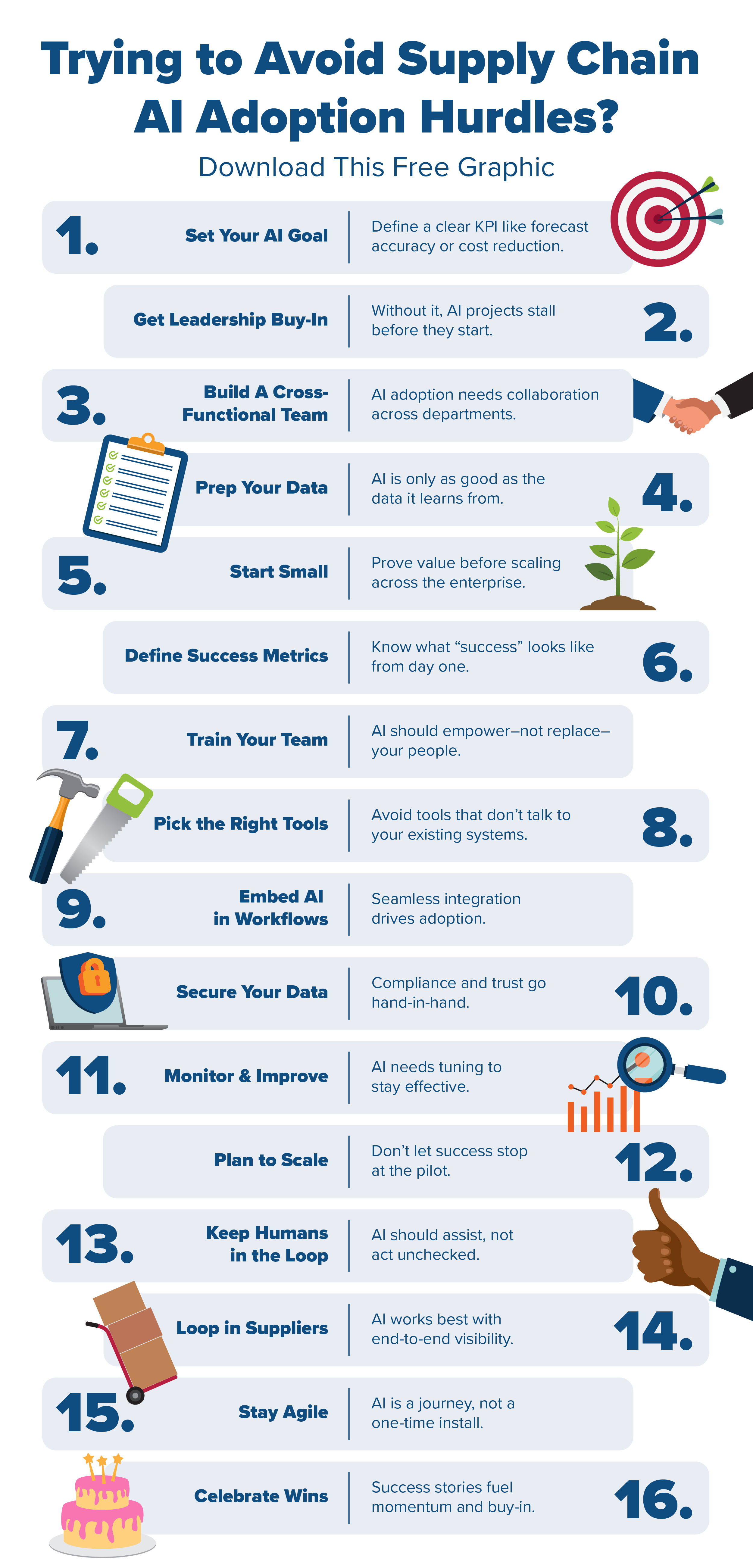
Adopting artificial intelligence in supply chain operations promises big gains – from better demand forecasts to automated logistics – but it also comes with significant challenges. Many organizations struggle with data issues, cultural resistance, high implementation costs, and more.
This article breaks down the key hurdles in AI adoption for supply chain management and, for each, explains how a business process outsourcing (BPO) partner like Group O can help overcome them. We’ll keep it informative and practical, focusing on insights rather than sales pitch.
Following the discussion of challenges, you’ll find a comprehensive checklist for scaling AI across supply chain operations – a step-by-step guide that operations teams can use to ensure they cover all critical considerations.
1. Data Quality and Siloed Systems
The Challenge: “AI is only as good as the information you feed into it.” In supply chain environments, data comes from everywhere – ERP systems, warehouse management, supplier portals, transportation logs – often in different formats and isolated in silos. If your data is incomplete, inconsistent, or locked in departmental silos, AI tools can’t generate reliable insights. Poor data quality or accessibility leads to bad predictions and erodes trust in AI. For example, if delivery records or supplier performance data are inaccurate, an AI system could optimize the wrong priorities, doing more harm than good. Data silos also mean no “single source of truth” for the supply chain, undermining any AI initiative.
How Group O Helps: As a BPO and supply chain specialist, Group O tackles data fragmentation head-on. First, Group O can integrate and manage data across the supply chain on the client’s behalf – consolidating information from multiple sources into one cohesive system. In practice, this might involve implementing advanced warehouse management systems (WMS) and integration middleware that bring together ERP, inventory, and supplier data streams. (In one client case, Group O introduced a WMS module that provided real-time visibility and status for inbound goods, dramatically reducing bottlenecks.) By ensuring data from different functions (procurement, logistics, inventory, etc.) is clean, up-to-date, and in a standard format, Group O creates a reliable data foundation for AI. We also offer rigorous data cleansing and governance processes – removing duplicates and errors so that AI algorithms aren’t led astray.
Moreover, Group O’s approach to supplier management inherently improves data quality. The company’s Supplier Management services continually measure and enforce the performance and quality of suppliers, tracking metrics like on-time delivery and product quality. By doing so, we generate high-quality data on supplier performance and compliance. When an AI system is applied (say, to predict supplier delays or choose optimal vendors), it’s leveraging accurate, vetted information rather than unreliable inputs. Group O’s role as a single point of data aggregation means clients escape the nightmare of patching together siloed spreadsheets. The result: better AI output. An AI model can confidently analyze, for example, a unified dataset of inventory levels and shipment ETAs to pinpoint risks, rather than juggling conflicting reports from different warehouses.
2. High Implementation Costs and ROI Pressure
The Challenge: Deploying AI in supply chain operations isn’t cheap. Implementing AI in supply chain operations often demands substantial upfront investment — from software and infrastructure upgrades to specialized talent. Yet despite rising budgets, many organizations struggle to realize meaningful returns. According to Deloitte, this paradox of increasing investment and elusive ROI is driven by fragmented strategies, unclear value metrics, and a rush to deploy without foundational readiness. When early pilots fail to deliver immediate impact, enthusiasm wanes, and funding dries up. This cycle of high expectations and premature judgment can stall AI adoption before it ever scales.
How Group O Helps: A BPO partner like Group O can significantly lower the barrier to entry for AI in a couple of ways. First, partnering with Group O shifts some of the investment burden away from the client. Instead of a company investing millions in building an AI-enabled supply chain control tower from scratch, they can leverage Group O’s existing technology stack and expertise. Group O has already invested in state-of-the-art supply chain systems – including automation, data analytics platforms, and AI-driven tools for forecasting and inventory management – as part of its service offerings. By outsourcing certain operations to Group O, clients essentially “rent” those AI capabilities and the supporting infrastructure, turning what would be a large capital expenditure into a more manageable operational expense. This makes AI adoption more cost-effective and scalable for the client.
Second, Group O’s experience helps in choosing high-impact, feasible AI projects that demonstrate quick wins. Because the company has a breadth of industry case studies, it can guide clients to identify use cases with relatively fast ROI – for instance, using AI for demand forecasting in a specific product line, or automating purchase order processing. This aligns with best practices of starting small and scaling fast. Group O might pilot an AI-powered solution in one distribution center or for one inventory segment to prove value. One example: Group O worked with a heavy machinery manufacturer to inject analytics and automation into its logistics – by first addressing a pain point in inventory dispositioning, the partnership delivered immediate improvements (faster processing of inbound goods and reduction in discrepancies). These quick improvements build the business case (e.g. cost savings, efficiency gains) needed to justify broader AI rollouts.
Finally, Group O can help manage ROI expectations by setting clear KPIs and transparent reporting. As an outsourced provider, we typically operate under service level agreements (SLAs) that define expected outcomes. Group O’s supply chain solutions come with built-in performance metrics – for example, real-time dashboards for inventory turns, order cycle times, and fulfillment accuracy. Regular reports show the tangible benefits achieved (say, a percentage reduction in carrying costs or improvement in on-time shipping). This data-driven approach keeps everyone honest about what AI is delivering. And if something isn’t hitting the mark, Group O’s team can tweak processes or algorithms to improve outcomes. In short, a partner like Group O shares the risk and responsibility of delivering ROI, which can greatly reassure companies worried about big AI investments.
3. Talent Gap and Technical Skills Shortage
The Challenge: Implementing AI in supply chain isn’t just a plug-and-play affair – it demands a mix of data science, AI engineering, and domain expertise. Many organizations simply don’t have enough people with the right skills. In fact, lack of skilled talent is a well-recognized hurdle: companies report difficulty finding staff who understand both advanced analytics and supply chain operations. A recent study found 75% of companies are adopting AI, but only 35% of workers say they’ve received AI training in the past year. This talent shortage and lack of training affects several areas: data engineers to integrate AI systems, data scientists to build or tune models, and even line managers who can interpret AI insights. Hiring such experts is competitive and costly. Additionally, existing supply chain staff might not be trained in AI tools – meaning even if the tech is in place, teams may not know how to fully leverage it. This gap can slow down adoption or lead to mis-implementation. In worst cases, AI systems are implemented incorrectly or under-utilized because users lack training, leading to project failure.
How Group O Helps: One of the advantages of partnering with a BPO like Group O is on-demand access to specialized expertise that a client might lack internally. Group O’s business model is built on providing comprehensive solutions, which means we have in-house experts in data analytics, process engineering, and AI-driven supply chain optimization. For example, Group O maintains a dedicated engineering and analytics team that digs into client processes and identifies opportunities for improvement. These are professionals who understand machine learning, big data, and how to apply them to things like inventory optimization or transportation routing. When a client engages Group O, we effectively gain a team of data experts and process engineers along with the service without having to hire or train those individuals themselves.
This directly addresses the talent gap. Group O’s team can handle the heavy lifting of data integration, model development, and system tuning. We also work closely with the client’s own staff to transfer knowledge and build comfort with the AI tools. For instance, if Group O deploys an AI-powered forecasting system, our experts will train the client’s planners on how to interpret the new forecast outputs, how to adjust parameters, and how to react to AI-driven alerts. In essence, Group O not only provides the technology but also the people who know how to run it. This was evident in a project with a global manufacturer where Group O became an extension of the manufacturer’s team, immersing themselves in the client’s operations. By embedding skilled personnel and sharing best practices, we have helped the client’s workforce climb the AI learning curve much faster than if they had to figure it out solo.
Because Group O spans multiple industries and supply chain functions, we bring pre-existing AI solutions and playbooks. For example, we’ve likely solved similar problems (like optimizing a warehouse layout with AI or automating quality checks) for other clients. That experience is invaluable: rather than reinventing the wheel, we can apply proven methods to a new client’s scenario. This means the client benefits from lessons learned elsewhere – a form of cross-pollination of expertise. Internally, Group O emphasizes continuous learning for our teams, keeping them up to date on the latest technology. As a client, you tap into that evolving knowledge base.
In short, Group O fills the AI skills void: you don’t need to immediately hire a PhD in machine learning or train your logistics manager in Python. The BPO’s experts design and run the AI-enhanced process, while your team learns by working alongside them. Over time, if the client wants to bring more in-house, they’ll be in a much stronger position, having already seen success in action.
4. Change Management and Employee Resistance
The Challenge: Change is hard and AI can be a very disruptive change in an operations environment. Front-line employees and even managers might show resistance to AI adoption for various reasons. A common fear is job security: will automation and AI workflows make their roles obsolete? In supply chain settings (warehouses, procurement offices, etc.), workers might worry that an AI-powered system or robots could replace their tasks. Even beyond job loss fears, there’s natural skepticism of new technology – especially something as opaque as AI, which can feel like a “black box.” People may be uncomfortable trusting AI recommendations (“Why should I trust this algorithm to set inventory levels? I’ve been doing this for 20 years!”).
Implementing AI often changes day-to-day processes, requiring folks to learn new tools or alter their routine. Without proper change management, internal pushback can seriously impede AI projects. In fact, resistance to change is noted as a major barrier, on par with technical issues. If employees don’t buy into the AI initiative, they might use it half-heartedly or find workarounds to avoid it, undermining the project’s benefits.
How Group O Helps: Successful AI adoption isn’t just about tech, it’s about people. Group O is very aware of this, and as a partner, we can act as both implementer and change agent. Here’s how we assist with the human side of AI:
Gradual Implementation and User-Friendly Tools: Group O often introduces AI-enabled improvements in a phased, non-threatening way. For example, instead of a sudden overhaul where a warehouse shifts overnight to autonomous robots, Group O might start by augmenting the existing process – like adding an AI-driven analysis that advises employees on optimal picking routes, while the employees still execute the picks. This way, the workforce experiences AI as a helper, not a replacement, from the start. Group O also prioritizes user-friendly applications – interfaces and dashboards that make it easy for employees to see the advantage of the new tools. By choosing technology that is intuitive (perhaps a visual dashboard for supply chain visibility), we can help reduce the intimidation factor.
Communication and Training: As part of our service delivery, Group O places heavy emphasis on training the client’s team and communicating the “why” behind changes. We help explain to stakeholders at all levels how AI will make work easier, not harder. For instance, Group O might hold workshops with procurement teams to demonstrate how an AI recommendation system can eliminate tedious manual analysis and help them secure better supplier terms faster. This echoes the advice: show employees how AI empowers them to do their jobs better and improves company performance (which in turn secures jobs). In previous engagements, Group O has facilitated training sessions that not only teach the new system but also address concerns head-on, emphasizing that the technology is there to assist, with humans still in control for oversight.
Stakeholder Inclusion: Group O often works on-site with client teams or closely alongside them, effectively becoming part of the workflow. This collaborative approach can ease tensions because the change doesn’t feel like an edict coming from an unfamiliar software vendor; instead, there are real people (Group O’s experts) working with your people. A great example is from a partnership with a construction equipment manufacturer that we’ve mentioned before - Group O’s team immersed themselves so deeply in the client’s operations that we “became an extension of the manufacturer’s team”. By doing so, we built trust and rapport with the internal staff. The employees saw that Group O understood their daily challenges and was there to help, not to judge or replace them.
Demonstrating Quick Wins: Nothing builds buy-in like success. Group O strives to achieve quick, visible improvements when rolling out an AI-related change. Whether it’s a noticeable reduction in backorders, a smoother month-end inventory reconciliation, or less overtime needed due to better forecasting, these wins help convert skeptics into advocates. Group O typically highlights these successes to the team: e.g., “Look, the new AI-driven scheduling cut your late shipments by 30% this month – that’s fewer angry phone calls you have to deal with.” Such proof points, coupled with recognition of employees’ role in that success, can turn resistance into pride.
Group O can significantly smooth the change management curve. We combine technical rollout with human-centric support, communicating benefits, training users, phasing in changes, and working side-by-side with the client’s workforce.
This comprehensive approach helps alleviate fears. Employees are more likely to embrace AI when they understand it and feel part of the journey, rather than having it imposed on them. The result is higher adoption rates and better utilization of AI tools, which ultimately drives the intended operational improvements.
5. Trust, Transparency, and Governance
The Challenge: AI doesn’t always explain itself. In supply chain decisions – which can impact millions of dollars of inventory or critical customer deliveries, trusting an algorithm is a major hurdle. Business leaders and operational managers might question the reliability of AI recommendations. They know that AI isn’t infallible and can make mistakes, especially if fed bad data (hence the data quality issue). If an AI system suggests something counterintuitive (like drastically cutting safety stock for a top-selling product), will planners trust it enough to act? Often, the answer is no – not without justification. The opaque nature of many AI models (the “black box” problem) can breed mistrust.
Moreover, there are real risks: an error in an automated decision could halt a production line or send shipments astray. Companies are rightfully cautious, insisting on human oversight. In a recent industry survey, a majority of executives favored a “human-in-the-loop” approach for AI in supply chain, ensuring people review or approve AI-driven actions. Building trust in AI is closely tied to demonstrating its accuracy over time and establishing proper governance. If AI is deployed without clear policies (for example, who is accountable if the AI makes a wrong call? what safeguards are in place?), organizations may hesitate to fully utilize it. In short, AI governance and trust are as important as the technology itself.
How Group O Helps: Group O addresses trust and governance in AI adoption through a combination of proven results, transparency, and controlled implementation:
Proven Use Cases and Data-Backed Results: One way to overcome mistrust is by showing evidence. Group O can draw on a portfolio of successful projects to reassure clients that AI works and that it can be kept in check. For instance, Group O might share how an AI tool improved forecast accuracy for another client by, say, 15%, leading to tangible benefits in stockout reduction.
Additionally, when Group O implements AI for a client, we often start with a period of close monitoring where the AI’s suggestions are compared with human decisions. In this phase, the client’s team can see the AI “getting it right” in a safe setting. Over time, consistent performance helps win trust. One philosophy we communicate is: “Trust but verify.” Group O will encourage clients to verify early outcomes and because we put strong data practices in place, many AI recommendations do prove valuable, gradually alleviating skepticism.
Human-in-the-Loop Approach: Group O designs its solutions to keep humans in control at the appropriate points. Rather than pushing for full automation from day one, we often configure AI systems to assist decision-makers. For example, if Group O deploys an AI engine for dynamic reorder point adjustment, the system might flag unusual recommendations for manual review. Nothing goes live without a human check until the client is comfortable. This kind of governance where AI suggests and humans dispose (approve/modify) stays in place until confidence is earned. Many companies find this hybrid model critical for comfort, and Group O is very willing to operate under such a model (in fact, 65% of executives prefer human oversight in AI use). Group O can also provide our own experts as part of this loop. We might have a data analyst double-check AI outputs daily and work with the client’s team to explain outliers, ensuring no blind leaps of faith.
Risk Management and Fail-safes: Being a seasoned operator in supply chain services, Group O understands where the pitfalls are. We incorporate safeguards to mitigate AI risks. For instance, thresholds can be set so that if an AI prediction falls outside normal parameters (say, it wants to cut inventory by 50% suddenly), it triggers an alert rather than an automatic action. Group O also helps establish governance policies: defining which decisions can be fully automated and which require sign-off, setting up an escalation process if an AI-optimized process starts to diverge from expected patterns, and so forth. This kind of governance framework ensures there is oversight and clarity and AI isn’t running wild; it’s governed by rules set jointly by Group O and our client.
Transparency and Explainability: Whenever possible, Group O favors AI solutions that can offer explainability. For example, if using a machine learning model for demand forecasting, we might configure it to highlight key drivers (“forecast increased because sales trend in region X is up” or “reduced because supplier Y reported a delay”). By surfacing reasons, even if simplified, the AI’s actions become more transparent to users, which builds trust. Additionally, Group O will be transparent about accuracy metrics: if a model is, say, 90% accurate historically, we will communicate the remaining uncertainty and advise on keeping contingency plans for that 10%. This honest communication helps set the right expectations and trust level – users know what the AI can and cannot do.
Group O acts as a trust bridge between the client and the new AI systems. We bring in a track record that breeds confidence, implement AI in a controlled, overseen manner, and put guardrails in place. The result is that over time, both leadership and staff can trust the AI as a reliable co-worker, not a mysterious intruder. As trust grows, companies are more willing to let the AI take on greater roles, knowing that proper governance is always in place to catch mistakes.
6. Supplier Management Complexity
The Challenge: Supply chains are not just within the four walls of an organization; they extend to a vast network of suppliers and partners. When adopting AI in supply chain operations, one often overlooked hurdle is managing the complexities of the supplier ecosystem. Many industries rely on hundreds or thousands of suppliers, each with their own data formats, reliability issues, and communication challenges. An AI system might need data on supplier lead times, quality stats, or capacity, but if suppliers aren’t providing data in a timely or usable way, the AI’s effectiveness suffers.
Optimizing a supply chain with AI might tell you that you need to adjust order schedules or inventory buffers per supplier, which can be very complicated to execute across so many external parties. There’s also the challenge of enforcement: suppose AI identifies that one supplier consistently causes delays – do you have the mechanisms to improve that supplier’s performance or switch sources? Many organizations struggle with supplier performance management, and AI will quickly surface those struggles (e.g., by pinpointing that your forecasts are off because one vendor’s delivery times are unpredictable).
Essentially, supplier management becomes a critical success factor for AI – without a strong handle on supplier data and performance, AI insights can’t be fully acted upon. In a recent marketing study, companies noted that aligning suppliers and breaking data silos between partners is a significant obstacle in realizing end-to-end supply chain AI benefits.
How Group O Helps: Supplier management is an area where Group O has deep expertise (independent of AI), and that expertise becomes a huge asset when layering AI on top:
Comprehensive Supplier Data and Monitoring: Group O’s supply chain services include robust supplier performance management programs. We track all the key metrics – on-time delivery, quality compliance, cost variances, communication responsiveness, etc. – for the suppliers involved in a client’s operation. By partnering with Group O, a company gains immediate visibility into supplier performance that it might not have had before. All of a sudden, data that was scattered in emails or not tracked at all is systematically collected. This creates a rich dataset for AI to consume. For example, if implementing AI to optimize inventory, the model can be fed with accurate lead time distributions for each supplier (maintained by Group O’s system) instead of generic or outdated assumptions. Good data in means better recommendations out. Group O essentially ensures that the AI has high-quality “supplier intelligence” to work with.
Supplier Collaboration and Consolidation: Group O often consolidates supplier interactions as part of its outsourcing solutions. For instance, a client might go from dealing with 50 different component suppliers to having Group O act as the single point of contact – Group O manages those 50 relationships behind the scenes. This has two benefits: (1) It simplifies the flow of information. Suppliers report to Group O, and Group O can enforce data standards (like every supplier must update shipment statuses on a central portal). So, an AI system has a single hub to check for updates, rather than interfacing with 50 systems or manual reports. (2) It gives the client leverage to act on AI insights. If AI identifies that 5 suppliers are causing most of the delays, Group O can step in to rectify that – maybe by working with those suppliers on improvement plans or by easily shifting volumes to alternate approved suppliers (since Group O likely has others in its network). This was demonstrated in a retail case study, where a big-box retailer had numerous print material suppliers causing logistics delays; Group O implemented a turnkey solution consolidating those services, resulting in up to 58% cost reduction and 99.8% on-time accuracy in deliveries. In essence, Group O simplified the supplier base and vastly improved consistency. This kind of streamlined supplier setup is ideal for AI to shine.
Predictive Supplier Management: Group O doesn’t just react; we also leverage analytics in supplier management. By partnering with them, clients can gain predictive insights into supplier risks (even without building it from scratch internally). For example, Group O might monitor macro indicators or use past data to flag a supplier that might fail to meet future demand spikes. We can feed such insights into the AI models or use them in conjunction with AI outputs. Imagine an AI that optimizes your inventory assuming all suppliers will meet lead times – and Group O interjects, “Except Supplier B is entering Chinese New Year period, expect 2-week extra delay.” Combining these, the plan can be adjusted proactively. Group O can effectively act as a human/AI hybrid layer for supplier management, catching issues that a pure algorithm might miss, and ensuring the AI plans are executed in the real world.
Executing on AI Recommendations: Perhaps most importantly, Group O can help execute the changes that AI deems necessary regarding suppliers. If the AI suggests diversifying away from a high-risk supplier, Group O can facilitate onboarding a new supplier (leveraging its network and procurement capabilities). If AI indicates you should renegotiate terms (like shorter lead times or penalty clauses for lateness), Group O’s procurement specialists can handle those negotiations with data in hand. We provide the muscle to act on insights. Many companies know what needs to be fixed with suppliers but lack bandwidth or relationships to drive change. Group O does that for a living.
Group O strengthens the weakest links in the supply chain – the external ones. By improving supplier reliability and integrating supplier data, we set the stage so that AI-driven efficiencies within the four walls aren’t negated by chaos outside. One might say Group O brings suppliers “into the fold” of your AI-enhanced supply chain, making the entire ecosystem more responsive and data-rich. This ensures that when AI optimizes end-to-end operations, it truly covers end-to-end – including that critical piece from your supplier’s factory floor to your loading dock.
With these challenges addressed – data ready, costs managed, skills in place, team onboard, trust established, and suppliers coordinated – an organization is poised to genuinely reap the rewards of AI in its supply chain. From here, the task becomes executing and scaling AI solutions thoughtfully.
To wrap up, we present a checklist for operations teams aimed at scaling AI across supply chain functions successfully. This checklist serves as a practical guide to ensure you’ve covered all bases, and it can easily be translated into a handy infographic or reference card for your team.
Checklist: Scaling AI Across Supply Chain Operations
Feel free to download the abbreviated version of our checklist image by right clicking on the image and selecting "save image as".
1. Define Clear Goals and Use Cases: Start by pinpointing what you want to achieve with AI in your supply chain. Is it demand forecasting accuracy? Faster warehouse throughput? Cost reduction in procurement? Be specific about the problem to solve or KPI to improve. Clear goals will guide all your decisions and help get leadership buy-in.
2. Secure Leadership Buy-In: Ensure executives and key decision-makers understand the value of the AI initiative and are on board. Executive sponsorship provides the project with resources and urgency. Share data or case studies to build a sense of urgency – e.g., note that 86% of companies see AI as essential, so this is a competitive imperative.
3. Build a Cross-Functional Team: Form a team that includes IT/data experts, supply chain process owners, and business analysts – and involve an external partner if needed. AI adoption isn’t just an “IT project” or a “supply chain project” – you need combined expertise. Having stakeholders from procurement, logistics, finance, and IT work together ensures all perspectives are covered and helps break down silos during implementation.
4. Inventory and Prepare Your Data: Data readiness is critical. Take stock of all relevant data sources (ERP, WMS, TMS, supplier databases, spreadsheets, etc.). Eliminate silos by integrating these sources or creating a data lake. Clean the data – fix errors, fill gaps, normalize formats – since AI outcomes will only be as good as the data quality. Establish a “single source of truth” for key data like inventory levels and supplier lead times.
5. Start with a Pilot Project: Don’t try to “boil the ocean” at first. Identify a pilot use case that is manageable in scope but meaningful in impact. For example, optimize inventory for a single product line, or automate invoice processing for one distribution center. Make sure it’s a scenario where you can measure results. Keep the pilot timeframe short (a few months). This lets the team learn and demonstrate success on a smaller scale before wider rollout.
6. Set Measurable KPIs: For your pilot (and eventual full project), define what success looks like in numbers. It could be “reduce inventory carrying cost by 10%”, “improve forecast accuracy to 85%+”, or “cut order processing time in half.” Establish baseline metrics and then track these KPIs throughout the project. Clear metrics keep everyone aligned and allow you to prove the AI’s value.
7. Engage and Train Employees: Bring your operations team into the process early. Explain the purpose of the AI tool and how it will help them. Provide training sessions and hands-on demos. By demystifying AI and showing employees it’s a tool for them (not against them), you’ll reduce resistance. Identify champions or super-users who can advocate for the technology among their peers.
8. Choose the Right Tools and Partners: Evaluate whether you will build AI solutions in-house or use external solutions. For many, a mix is best: maybe you use a proven AI software for demand planning, and you partner with experts (like Group O or a tech provider) to implement and tailor it. Select tools that fit your needs and integrate with your existing systems. If internal expertise is thin, strongly consider partnering with a BPO or consulting firm that has done this before. They can accelerate implementation and provide technical muscle.
9. Integrate AI into Existing Workflows: Ensure the AI system is connected to your operational systems. This might mean linking an AI platform to your ERP so it can pull order data or configuring it to write back recommended purchase orders into your procurement system. Embedding AI into the normal flow of work (rather than keeping it as a separate side system) increases adoption – e.g., planners see AI suggestions right in the tools they already use. Also, design processes so that it’s clear how human and AI interact (who finalizes decisions, how to handle overrides, etc.).
10. Ensure Data Security and Compliance: When implementing AI, particularly if using cloud services or external partners, review your data security protocols. Protect sensitive supply chain data (product designs, contract terms, customer info) with proper access controls and encryption. Also, if your industry has regulations (like data privacy or export controls), make sure your AI solution complies. Building trust in the AI also means knowing it’s secure and ethically used.
11. Monitor, Measure, and Iterate: Once the AI solution is live, continuously monitor its performance. Set up dashboards or reports for the KPIs you defined and review them regularly. Is the AI achieving the expected outcomes? Identify any deviations or unexpected results. Gather feedback from users – are they finding it helpful, or are there pain points? Use this information to refine the system. AI adoption isn’t a one-and-done project; it’s an ongoing improvement cycle. For instance, you might retrain models with newer data, adjust parameters, or improve the user interface based on feedback.
12. Plan for Scale-Up Early: If the pilot is successful, have a plan for how you will scale it to broader operations. Consider the infrastructure needs – can your systems handle a 10x increase in data or users if you expand the AI to all product lines or facilities? Identify any new integrations needed for scaling. Also, budget and roadmap the next phases: e.g., rolling out to other warehouses next quarter, then extending to transportation scheduling. A staged scale plan keeps momentum and ensures each expansion is well-supported (with training and resources).
13. Maintain Human Oversight and Governance: As you scale AI, put formal governance in place. Define roles and responsibilities for the AI system’s outcomes – for example, assign an “AI process owner” who will monitor its decisions and handle exceptions. Set up an oversight committee if the AI impacts many departments. Keep humans in the loop, especially for critical decisions. Make it clear when and how employees should intervene or can override the AI. This not only guards against errors but also keeps trust high.
14. Collaborate with Suppliers and Partners: Ensure your suppliers and logistics partners are part of the AI integration. Share relevant data with them and, if possible, integrate their systems too. For example, connect your AI platform with a supplier’s inventory data or your 3PL’s transportation management system, so the AI has end-to-end visibility. You may also need to set expectations or agreements with partners – e.g., ask key suppliers to provide more frequent data updates to feed your AI models. If working with a BPO like Group O, leverage their supplier management capabilities to streamline this process.
15. Stay Agile and Informed: AI technology and supply chain conditions both evolve. Stay up-to-date with the latest AI advancements (perhaps new algorithms or software features) and with industry trends (new disruptions, market shifts). Be ready to update your AI strategy accordingly. Maybe next year you’ll incorporate a new AI capability like cognitive automation for invoice processing or adjust your models because of a new trade regulation affecting lead times. Encourage a culture of continuous learning in your team – the more AI becomes part of your operations, the more your team should grow with it.
16. Celebrate and Communicate Wins: As you progress, highlight the successes attributable to AI. Did on-time delivery improve? Was there a cost saving or efficiency gain? Communicate these wins to the whole organization. This not only reinforces leadership support but also boosts morale and buy-in among employees (“this is working!”). It helps cement AI as a welcomed part of the operations culture rather than a trial project. Recognize the people involved in making it succeed – both the tech team and the operational folks who adapted. This positivity will fuel further adoption and collaboration.
Using this checklist, operations teams can systematically navigate the journey of AI adoption – from conception to full scale. The key is to address both technical and human factors, plan diligently, and iterate based on real-world feedback.
Overcome AI Hurdles With the Right Approach & Partnership
Adopting AI in supply chain operations is a multi-faceted challenge, but it’s one that can be overcome with the right approach and partnerships. Companies that succeed do so by tackling data issues upfront, fostering a culture open to change, investing smartly (and patiently) in technology and skills, and leveraging partners to fill gaps – be it in expertise or execution.
Group O, as a BPO provider, exemplifies the kind of partner that can accelerate this journey: by providing the data foundation, the expert talent, the change management support, and the supplier network optimization that allow AI solutions to truly deliver value.
The hurdles are significant – from siloed data and skeptical staff to complex supplier webs – yet each hurdle can be transformed into a stepping stone. With robust planning and help from experts, AI can evolve from a buzzword to a practical, day-to-day asset in your supply chain, driving efficiency and resilience.
As you prepare for this transformation, keep the focus on both your people and processes, and use guides like the checklist above to stay on track. The supply chains that embrace AI thoughtfully and holistically will be the ones setting industry benchmarks in the years ahead, and with the right strategy, yours can be among them.
 About the Authors
Jeremiah Green is a Program Manager in the Group O Supply Chain Division, supporting strategic growth through continuous improvement, cost reduction, and business intelligence development across client supply chains. With a data-driven approach, he focuses on uncovering opportunities that improve operational efficiency and long-term supply chain performance.


Cory Schounick focuses on strategic technology transformation and practical, value-driven AI. With a foundation in Operations Research and Machine Learning from USC, he helps guide Group O’s technology evolution aligning modernization, automation, and AI governance to improve efficiency, reliability, and human-centric customer experiences while turning innovation into real-world execution.