
Inclusive, Accessible & Sustainable Incentives


Tags: 2026 Incentive Marketing Series, Incentives & Rebates
Designing Programs That Work for More People
2026 Incentive Strategy Roadmap | Mile 11
We're approaching the final stretch of the 2026 Incentive Strategy Roadmap.
Over the past ten months, we've looked at the entire lifecycle of a modern incentive program, from establishing an innovation baseline and aligning programs around measurable objectives to modernizing rebates, using first-party data responsibly, expanding payment choice, improving participant experience, managing compliance, strengthening channel programs, measuring ROI, and putting AI to work responsibly. Along the way, one theme has remained consistent: incentives perform best when they are designed around the people expected to participate, not simply the processes and technology used to deliver them.
The progression has been intentional. Modern incentive programs are not a collection of individual tactics. They are connected systems where strategy, technology, payments, operations, customer care, analytics, and risk management all influence the participant experience and ultimately the program's performance. A barrier or source of friction at any point in that system can reduce participation, limit engagement, or diminish the perceived value of the reward. That end-to-end approach also reflects how Group O is thinking about incentive operations internally. The objective is not simply to make programs more efficient, but to make them easier for participants to understand, access, and use while continuing to deliver measurable value for the organizations sponsoring them.
If you missed any of the previous miles, you can explore the complete 2026 Incentive Strategy Roadmap series.
This month, we're taking another step forward. We're expanding the definition of an effective participant experience by considering where differences among participants can create unintended barriers or opportunities for better program design.
Once you've built a program that is fast, measurable, secure, personalized, and increasingly intelligent, the next question should be:
Does it actually work for everyone you are trying to reach?
That means looking at incentive programs through three closely connected lenses: inclusion, accessibility, and sustainability.
Participants don't all experience incentive programs the same way. Differences in access, preferences, abilities, and circumstances can create friction, while thoughtful choices around rewards and fulfillment can improve both accessibility and sustainability. Designing for more people means providing the flexibility and choice that turn these principles into stronger participation and program performance.
Enjoy the rest of your journey as we flush out these lenses further!
Inclusive, Accessible & Sustainable Incentives
A program can have a compelling reward and sophisticated technology and still create a poor experience.
Maybe the reward isn't useful to a participant.
Maybe the redemption process is difficult to navigate on a mobile device.
Maybe eligibility requirements are hard to understand.
Maybe a participant doesn't have access to the payment method you've selected.
Maybe a digital experience isn't accessible to someone using assistive technology.
Or maybe a reward is earned, but ultimately goes unused.
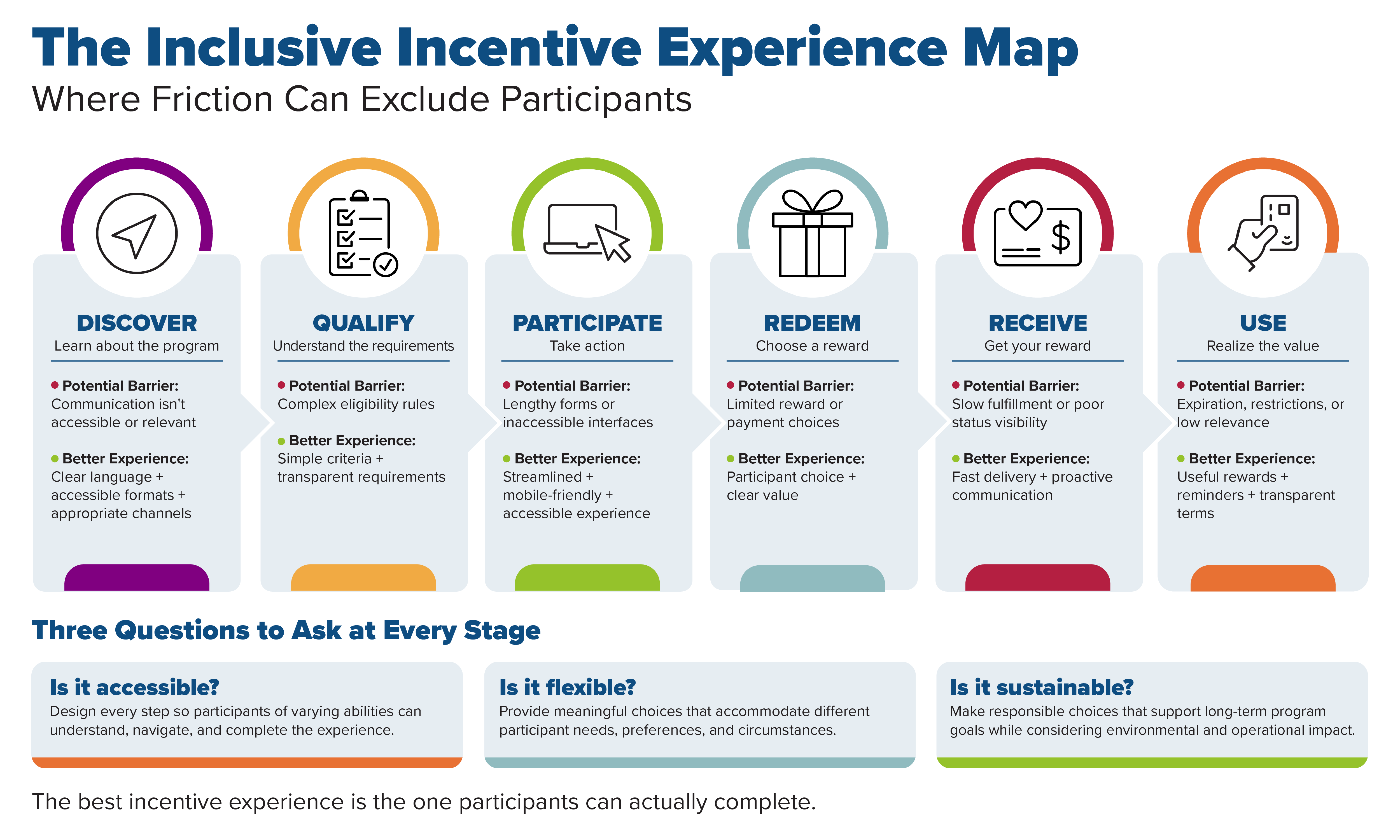
Every one of those situations creates something we've discussed throughout this series: friction.
Our focus in June was on reducing unnecessary steps between earn, redeem, and use. That remains important here. Incentives compete with the digital experiences people encounter every day, and complicated processes create barriers to engagement. Group O's broader roadmap has consistently positioned friction reduction, participant choice, and seamless redemption as essential parts of a modern program.
Inclusive program design expands that idea.
The objective isn't necessarily to build a completely different experience for every participant. It's to design enough flexibility into the program that more people can successfully participate.
Inclusion Starts With Choice
It is easy to think of inclusion as a demographic issue.
Incentive marketers need to think more broadly.
Participants differ in geography, age, technology comfort, financial preferences, language, accessibility requirements, and what they consider valuable.
Someone may prefer an instant digital payment.
Someone else may prefer a physical card.
Another participant may value merchandise, an experience, or the ability to choose something personally meaningful.
Offering choice reduces the risk of designing the entire program around what we assume participants want.
The Incentive Research Foundation's 2026 participant-preference research reinforces the importance of understanding how different groups experience rewards and recognition rather than assuming a uniform participant response. Its U.S. study included 400 participants across age groups, income levels, industries, organizational roles, and tenure levels.
For program owners, that translates into practical questions:
• Are we offering reward options that are relevant across our participant population?
• Can participants access rewards through the technologies they actually use?
• Are we unnecessarily limiting how participants receive value?
• Are program rules understandable without insider knowledge?
• Are we creating barriers that have nothing to do with the behavior we're trying to motivate?
Inclusion isn't about offering everything to everyone.
It's about understanding your audience well enough to avoid creating unnecessary barriers. Download our Inclusive Incenive Experience Map below by right clicking on the image and clicking "Save Image As".
Accessibility Is Part of Participant Experience
Accessibility is sometimes approached as a final-stage compliance review.
That's too late.
Accessibility should be considered when the participant journey is designed.
The U.S. Department of Justice warns that inaccessible web content can deny people with disabilities equal access to information and identifies common digital barriers including insufficient color contrast, relying on color alone to communicate information, and missing text alternatives for images.
For a digital incentive experience, accessibility considerations can extend across:
Program Communications: Use straightforward language, meaningful headings, readable typography, appropriate contrast, and alternatives for visual information.
Enrollment & Claim Submission: Forms should be intuitive, clearly labeled, keyboard navigable where applicable, and designed to avoid unnecessary steps.
Reward Selection: Participants should be able to understand what reward options are available, their value, restrictions, and expiration requirements.
Customer Care: Participants who encounter digital barriers should have another reasonable way to receive assistance.
Mobile Experiences: A process that technically works on a smartphone isn't necessarily an easy or accessible mobile experience.
Depending on the organization and program, formal accessibility requirements may also apply. The U.S. Access Board, for example, maintains ICT accessibility standards addressing access for people with physical, sensory, and cognitive disabilities, including compatibility with assistive technologies.
The important lesson for incentive marketers is simpler: Accessibility is good experience design. Removing a barrier for someone who needs an accommodation often makes the same process easier for everyone else.
Reduce Friction Without Losing Program Integrity
There is an important distinction between removing unnecessary friction and removing necessary program controls.
A well-designed program still needs:
• Clear eligibility criteria
• Fraud prevention
• Validation requirements
• Required disclosures
• Appropriate financial controls
• Compliance safeguards
The goal isn't to remove these protections.
The goal is to implement them without making legitimate participants work unnecessarily hard to receive what they've earned.
This is something we've discussed throughout the Roadmap. We have emphasized that program design should begin with a clear understanding of both your financial objectives and your customer experience objectives, with business rules integrated into the program from the beginning.
That's an important distinction.
A participant shouldn't have to guess whether they qualify. They shouldn't have to dig through lengthy documentation to understand the offer. They shouldn't submit information twice because systems don't communicate. And they shouldn't call customer care simply to determine where their reward is.
Every avoidable step is another opportunity for disengagement.
Sustainability Is More Than the Reward Itself
Sustainability introduces another important question:
What impact does the incentive create beyond the immediate transaction?
Incentive sustainability can certainly involve reward selection, travel, merchandise, packaging, shipping, and fulfillment. But organizations should look at the entire program.
Opportunities might include:
• Digital reward and payment options
• Reduced reliance on unnecessary physical materials
• Thoughtful reward sourcing
• More efficient fulfillment
• Consolidated shipments where appropriate
• Local experiences or reward options
• Charitable giving choices
• Participant choice between physical and digital rewards
IRF research found that almost 80% of respondents reported at least some client pressure to provide more sustainable options in meetings, events, incentive travel, venues, and transportation. The same research identified cost as the primary barrier to sustainability initiatives.
That's an important reminder that sustainability cannot exist independently of program economics.
The objective is not to add a "green" feature to a program because it sounds good. The objective is to identify options that make sense for the participant, support the brand's broader commitments, and remain financially and operationally sustainable.
In some cases, those goals reinforce each other.
IRF notes that options closer to home can potentially reduce environmental impact and cost, while local suppliers and experiences can support the surrounding economy.
Sustainability works best when it is built into program design rather than added later as a marketing message.
What Happens to Rewards That Aren't Used?
There's another side of sustainability that doesn't get discussed enough in incentive planning:
What happens when a reward goes unused?
Unused rewards can result from several causes.
Participants may forget about them. They may have difficulty accessing them. An expiration date may pass. The reward may not be relevant. Or friction somewhere between earning and using the reward may prevent completion.
From an operational standpoint, those scenarios can involve contractual, accounting, legal, tax, escheatment, or unclaimed-property considerations depending on the reward type, jurisdiction, and program structure.
But we should also look at unused rewards through the participant experience lens.
If a participant earned a reward but never received the intended value, was the program completely successful?
Program managers should monitor:
• Reward issuance versus redemption
• Time from earning to fulfillment
• Unused or unredeemed value
• Participant inquiries related to accessing rewards
• Reward expiration patterns
• Drop-off points between qualification and redemption
• Differences in utilization by reward type or participant segment
Those metrics can reveal friction that top-level participation numbers don't show.
They can also inform program decisions. Maybe communications need to change. Maybe participants need reminders. Maybe reward choice needs to expand. Or perhaps the redemption experience itself needs attention.
As we've previously highlighted, repeat engagement, redemption activity, and how quickly participants move from earning to using rewards are valuable signals of whether a program is delivering value. Just as importantly, program owners need to understand where people drop off.
Design for the Participant, Not the Program
Throughout this Roadmap, we've talked a lot about technology, automation, data, payments, analytics, and AI.
Those capabilities matter.
But technology shouldn't make the participant work harder.
Better incentive infrastructure should make complexity largely invisible to the person using it.
A participant shouldn't need to understand the systems behind a program. The participant needs to know:
What do I need to do? What will I receive? How do I receive it? Where can I get help?
Great program design makes those answers obvious.
Behind that simple experience may sit sophisticated technology, integrated payment systems, automated claims validation, fraud controls, multilingual customer care, analytics, and reporting.
That's the point.
The operation can be complex. The participant experience shouldn't be.
Building Inclusion Into the Incentive Lifecycle
For organizations planning future programs, inclusive design should be considered throughout the lifecycle rather than addressed in a single program requirement.
Plan: Understand the audience, objectives, access requirements, reward preferences, and potential barriers.
Design: Build flexibility into rewards, payment methods, communication channels, and program experiences.
Execute: Make participation, validation, redemption, fulfillment, and support as straightforward as possible.
Measure: Look beyond participation and examine abandonment, reward utilization, support contacts, fulfillment, and engagement across participant segments.
Improve: Use participant behavior and operational data to identify friction and refine the program.
This fits directly with Group O's broader operating philosophy: Design + Configure → Launch + Engage + Validate + Pay + Support → Analyze + Optimize.
Accessibility, inclusion, and sustainability shouldn't be separate initiatives sitting beside that lifecycle. They should influence decisions throughout it.
Key Terms for This Article
Inclusive Incentive Design: An approach to program development that considers differences in participant needs, preferences, circumstances, and access when designing participation and reward experiences.
Accessibility: Designing experiences so people with differing physical, sensory, or cognitive abilities can access and use program information, technology, services, and support.
Participant Choice: Providing appropriate options in rewards, payments, communications, or experiences so participants can select a method that best meets their needs.
Friction: Any unnecessary step, delay, barrier, confusion, or effort that makes it harder for a participant to complete the incentive journey.
Sustainable Incentives: Incentive strategies designed with environmental, social, economic, and long-term operational considerations in mind.
Reward Utilization: The extent to which issued or earned rewards are ultimately accessed and used by participants.
Unused Rewards: Reward value that participants have earned or received but have not redeemed or used, subject to the specific rules, legal requirements, and structure governing the program.
Assistive Technology: Tools and technologies that help people with disabilities interact with digital information and services, including screen readers, voice-recognition software, and other accessibility technologies. The U.S. Department of Justice specifically identifies these technologies in its web-accessibility guidance.
Data Points & Market Insights
1. Almost 80% of respondents in Incentive Research Foundation research reported at least some client pressure to provide more sustainable options across meetings, events, incentive travel venues, and transportation. Cost was identified as the leading barrier to adoption.
2. Sustainability is increasingly viewed as a long-term incentive-program consideration. In 2024 Incentive Travel Index findings cited by IRF, 19% of European respondents considered sustainability a short-run challenge, while 33% considered it a long-run challenge.
3. IRF's 2026 participant research found that nearly 40% of respondents regularly set personal goals related to earning rewards or recognition, while another 43% did so occasionally, reinforcing how reward programs can influence participant behavior.
4. U.S. Department of Justice guidance specifically identifies inaccessible web content as a barrier to equal access and points to issues such as insufficient color contrast, color-only instructions, and missing alternative text as common digital accessibility problems.
5. IRF research notes that sustainable reward and benefit options are becoming more prevalent, including charitable contributions and other socially responsible reward choices, extending sustainability beyond simply reducing the physical footprint of a program.
December: Looking Ahead to 2027
We started 2026 by asking what a modern incentive program needs to look like. In December, we'll bring the Roadmap full circle.
Our final mile will look ahead to 2027 and beyond, exploring the trends shaping the next generation of incentive programs and the strategic decisions organizations should begin making now.
We'll revisit the themes that defined this year's Roadmap, including participant experience, digital payments, data, measurement, compliance, AI, accessibility, and operational infrastructure, and examine what they collectively tell us about where incentive strategy is headed.
Because the biggest lesson of 2026 may be this:
The future of incentives isn't about any single technology, reward type, or trend. It's about building programs that can continue to adapt.
 About the Author
Paul Flemr is Senior Vice President of Incentive Marketing Solutions at Group O, bringing more than 17 years of leadership experience across operations, customer care, and incentive marketing. Throughout his career at Group O, Paul has held progressive roles spanning Customer Care, Operations, and Executive Leadership, giving him a uniquely end‑to‑end perspective on building and delivering high‑impact incentive programs. Known for his passion for concierge‑level client service, Paul is deeply committed to ensuring incentive marketing clients receive seamless, white‑glove support—from strategy and program design through execution and fulfillment. He is a strong advocate for embracing new technology and innovative ideas to continuously elevate program performance and the client experience. As an author for The 2026 Incentive Strategy Roadmap, Paul brings practical insight, operational expertise, and a forward‑looking mindset to help organizations design incentive programs that drive engagement, loyalty, and measurable results.
