
Designing Partner Programs for Growth in 2027


Tags: 2026 Incentive Marketing Series, Incentives & Rebates
2026 Incentive Strategy Roadmap | Mile 8
As we continue our 2026 Incentive Strategy Roadmap, one theme has surfaced repeatedly: incentive programs are no longer simply reward mechanisms. They have become strategic business tools that influence behavior, strengthen relationships, and drive measurable performance.
.webp)
Earlier articles explored everything from innovation baselines and measurable program design to digital disbursements, participant experience, and compliance. Together, these topics have highlighted a larger shift occurring across the incentive industry. Organizations are moving away from static programs and toward flexible ecosystems built around technology, transparency, personalization, and trust.
This month, we turn our attention to one of the most influential components of the incentive landscape: Channel & B2B Incentives.
For manufacturers, distributors, technology providers, and organizations that rely on indirect sales channels, partners are often the primary path to market. Yet many channel programs still rely on outdated structures focused exclusively on end-of-year rebates or broad volume targets. As organizations begin planning for 2027, leading brands are rethinking how incentives are designed, measured, and delivered.
The question is no longer whether channel incentives matter.
The question is whether your channel incentive strategy is motivating the behaviors that matter most.
Why Channel Incentives Matter More Than Ever
Today's channel ecosystem is more complex than ever before.
Partners are managing multiple vendor relationships, navigating competitive market pressures, and deciding where to invest their time, training, and sales resources. Research from the Incentive Research Foundation notes that channel partners frequently participate in numerous incentive programs simultaneously, making simplicity, relevance, and perceived value critical differentiators.
At the same time, manufacturers and brands face increasing pressure to:
• Accelerate new customer acquisition
• Protect and grow market share
• Improve partner engagement
• Expand product adoption
• Generate measurable ROI
• Maintain compliance and accountability
The result is a significant shift in how channel incentives are structured.
From Flat Rebates to Strategic Accelerators
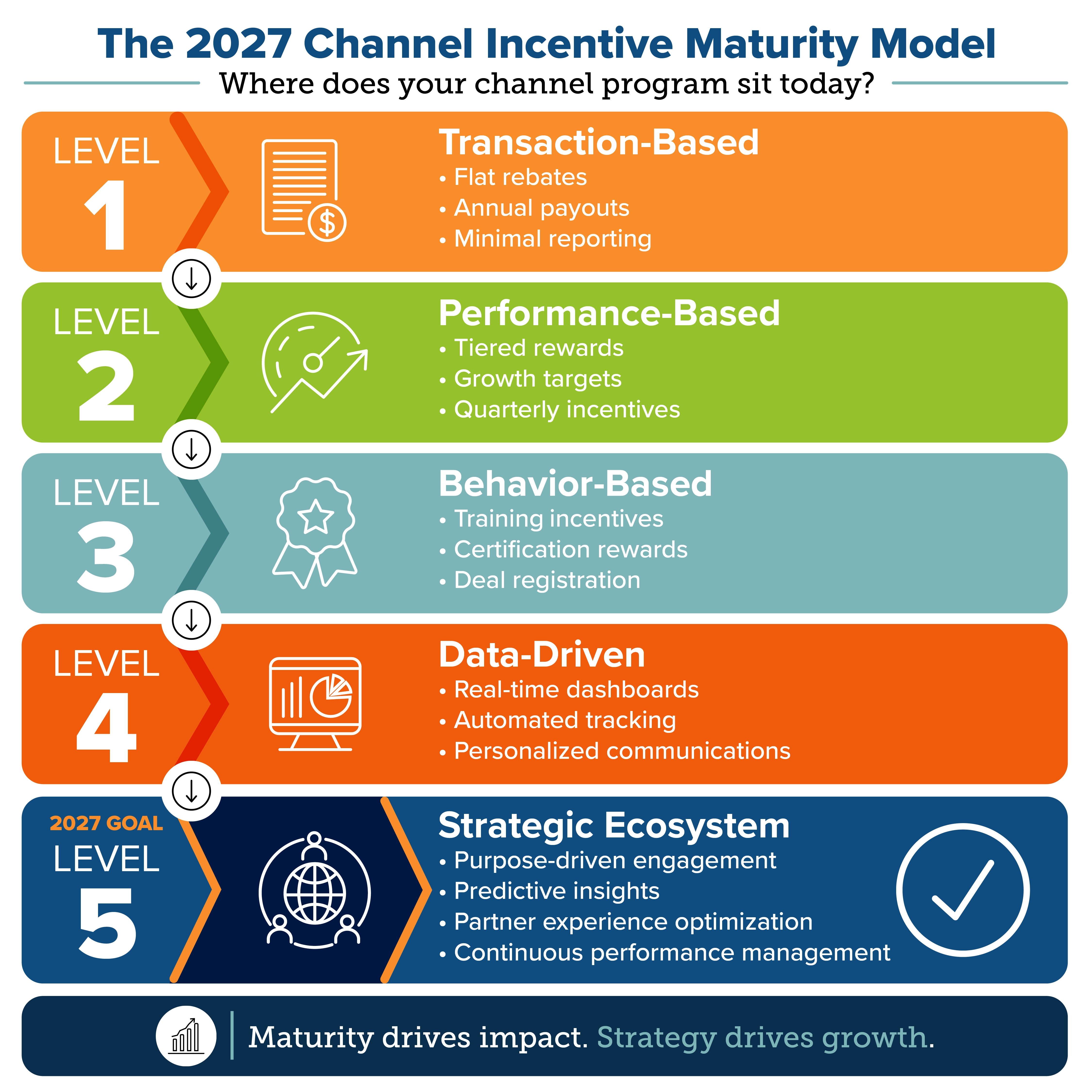
For years, many channel programs relied on straightforward volume-based rebates. While these programs remain useful in some situations, many organizations are shifting toward incentives that support specific business outcomes.
Rather than rewarding every transaction equally, organizations are increasingly creating accelerators tied to strategic growth initiatives such as:
• New customer acquisition
• Expansion into new markets
• Increased product mix adoption
• Priority product growth
• Cross-selling and upselling activities
These structures allow organizations to align incentive investments with business goals instead of simply rewarding existing purchasing behavior.
A partner that helps generate net-new business may create significantly more long-term value than one maintaining historical purchasing patterns. Incentive structures should recognize that difference.
Reward Behaviors, Not Just Transactions
One of the biggest shifts shaping 2027 planning is the move toward behavior-based incentives.
Sales outcomes matter, but outcomes are often the result of actions taken well before a transaction occurs.
Progressive channel programs now reward behaviors such as:
• Technical certification completion
• Deal registration
• Product training participation
• Customer demonstrations
• Solution assessments
• Multi-account penetration
• Lead generation activities
• Joint marketing participation
These behaviors create future revenue while helping partners build expertise and deepen relationships with customers.
Research published by the Incentive Research Foundation found that top-performing channel programs increasingly recognize the full behavioral pipeline that leads to sales success rather than focusing solely on booked revenue.
When organizations reward the right activities, they create momentum before the sale happens.
Purpose, Recognition, and Meaningful Connection
Partner expectations continue to evolve.
Just as customer loyalty programs have shifted toward more personalized engagement models, channel incentive programs are becoming more experience-driven and purpose-oriented.
Recent industry conversations highlighted by Loyalty360 emphasize that engagement is becoming increasingly dependent on relevance, personalization, and meaningful value exchange rather than generic rewards alone.
Organizations are finding success through:
• Regional recognition events
• Small-group experiences
• Personalized rewards
• Wellness-focused opportunities
• Skills-development incentives
• Values-driven recognition
While premium rewards still have a place, many partners increasingly value experiences and opportunities that strengthen professional relationships and support personal growth.
As discussed in our recent exploration of the future of loyalty programs, organizations that create stronger emotional connections often generate stronger long-term engagement.
The future of incentives is not simply bigger rewards. It is creating more meaningful reasons to participate.
Best Practices so that Operations Teams can Plan
Great incentive strategies fail every year because execution fails.
As organizations prepare for 2027, operational excellence is becoming just as important as incentive design.
Segment Your Channel Ecosystem
Not all partners are alike.
Treating distributors, VARs, MSPs, resellers, dealers, and integrators as a single audience often results in poor participation and reduced effectiveness.
Instead, organizations should segment partners by:
• Business model
• Revenue potential
• Geographic region
• Technical capability
• Program maturity
• Strategic importance
A high-performing distributor may require an entirely different incentive approach than a new regional reseller.
Thoughtful segmentation ensures the right incentives reach the right audience.
Prioritize Real-Time Visibility
Transparency has become one of the most important success factors in partner engagement.
Partners want immediate visibility into performance, progress, earnings, and qualification status.
Programs supported by integrated technology platforms can provide:
• Real-time performance dashboards
• Automated claim validation
• Faster reward processing
• Improved reporting accuracy
• Reduced administrative burden
When participants always know where they stand, trust increases and participation typically follows.
This aligns with a broader trend we have discussed throughout this series: modern incentive programs increasingly compete with the digital experiences participants encounter every day. Delayed reporting and manual processes create friction that can negatively impact engagement.
Simplify Program Communication
Many incentive programs unintentionally create barriers through complexity.
If participants need a lengthy PDF to understand program rules, engagement often suffers.
The most effective programs communicate:
• Goals clearly
• Rules simply
• Progress visibly
• Rewards transparently
Participants should be able to answer three questions immediately:
• What do I need to do?
• What will I earn?
• How do I track progress?
Clarity drives participation. Complexity drives disengagement.
Transparency, Compliance & Governance
As incentive programs grow in sophistication, compliance becomes increasingly important.
Organizations must manage requirements related to:
• Tax reporting
• Data privacy
• Financial controls
• Reward fulfillment
• Program disclosures
• Audit readiness
• Fraud prevention
Compliance should not be viewed as an afterthought. It should be incorporated into program planning from the beginning.
Organizations that proactively address governance build stronger partner trust, reduce risk, and create more sustainable programs.
This was a key takeaway from our previous discussion on risk, compliance, and ethics. Trust is not created at payout. It is built throughout the participant experience.
At Group O, we help organizations navigate these complexities by supporting the entire incentive lifecycle, including program strategy, technology, communications, fulfillment, reporting, customer support, and compliance-focused administration. This is how we can be your program partner, and we're excited to get started.
In September We Focus On Measuring Incentive ROI
Designing an effective incentive program is only part of the equation. To secure executive buy-in, optimize future investments, and demonstrate lasting business value, organizations must be able to measure what their programs are truly delivering. In September, we'll tackle one of the most important topics in the entire 2026 Incentive Strategy Roadmap: Measuring Incentive ROI. We'll explore how to connect incentive activity to business outcomes, assess true program impact beyond participation metrics, and use performance data to continuously improve results.
If you've ever been asked, "Is our incentive program really working?" this is an article you won't want to miss.
Key Terms for This Article
Channel Incentive: A reward program designed to motivate distributors, dealers, resellers, or other indirect sales partners to achieve specific business objectives.
Deal Registration: A process that allows channel partners to document sales opportunities and receive incentive credit or protection.
Channel Incentive Management (CIM): Technology platforms (like O-vations™) and processes used to administer, track, validate, and report channel incentive programs.
Behavioral Incentive: A reward structure that encourages specific actions or milestones rather than rewarding sales volume alone.
Partner Segmentation: The practice of grouping channel partners based on shared characteristics such as partner type, maturity, capability, or revenue potential.
Strategic Accelerator: An enhanced incentive tied to high-priority business goals such as new customer acquisition, product adoption, or market expansion.
Data Points & Market Insights
The Incentive Marketing Association represents organizations across what it identifies as a $90 billion incentive industry, reflecting the continued strategic importance of incentives within business growth programs.
Research from the Incentive Research Foundation notes that channel partners often participate in multiple programs simultaneously, making simplicity, visibility, and relevance increasingly important.
The Incentive Research Foundation reports that many leading channel programs now reward behaviors such as training completion, certifications, deal registration, and partner development activities in addition to sales outcomes.
U.S. Census Bureau data showed merchant wholesale sales reached $817.4 billion in May 2026, up 18.1% year-over-year, highlighting continued growth across distribution and partner ecosystems.
Industry research supported by the Incentive Research Foundation found that moving performance among the middle majority of participants often creates greater overall revenue impact than focusing exclusively on top performers.
 About the Author
Paul Flemr is Senior Vice President of Incentive Marketing Solutions at Group O, bringing more than 17 years of leadership experience across operations, customer care, and incentive marketing. Throughout his career at Group O, Paul has held progressive roles spanning Customer Care, Operations, and Executive Leadership, giving him a uniquely end‑to‑end perspective on building and delivering high‑impact incentive programs. Known for his passion for concierge‑level client service, Paul is deeply committed to ensuring incentive marketing clients receive seamless, white‑glove support—from strategy and program design through execution and fulfillment. He is a strong advocate for embracing new technology and innovative ideas to continuously elevate program performance and the client experience. As an author for The 2026 Incentive Strategy Roadmap, Paul brings practical insight, operational expertise, and a forward‑looking mindset to help organizations design incentive programs that drive engagement, loyalty, and measurable results.
