
AI in Incentive Operations: Finding the Balance


Tags: 2026 Incentive Marketing Series, Incentives & Rebates
2026 Incentive Strategy Roadmap | Mile 10
 As we enter the tenth mile of our 2026 Incentive Strategy Roadmap, one message has consistently appeared throughout the series: the most successful incentive programs combine technology, data, operational excellence, and human-centered design.
Over the past nine months, we've explored the innovation baseline for modern incentives, North Star metrics, real-time rebates, first-party data, digital disbursements, participant experience, compliance, channel incentives, and ROI measurement. Together, these topics illustrate a larger industry evolution. Incentive programs have moved far beyond simple rewards and rebates. They are increasingly becoming sophisticated ecosystems that leverage technology, analytics, compliance controls, and personalized experiences to influence behavior and deliver measurable business outcomes.
This month, we turn our attention to one of the most discussed topics in business today: Artificial Intelligence.
The question is no longer whether AI will impact incentive programs. It already has.
The question is how organizations can use AI responsibly to improve efficiency, help prevent risk, reduce friction, and create better participant experiences without losing the human element that remains critical to program success and participant trust.
To Fully Automate with AI or Not to? That is the Question!
It is pretty clear that artificial intelligence is quickly moved from future-state discussion to practical business tool.
Organizations across nearly every industry including incentive marketing are evaluating how AI can automate repetitive tasks, improve decision-making, identify risk, and uncover opportunities for optimization. Incentive management is no exception.
However, AI should never be viewed as a replacement for people.
The most effective programs use AI to enhance human expertise rather than eliminate it.
When applied thoughtfully, AI can help organizations:
• Accelerate validation and eligibility reviews
• Detect potential fraud patterns
• Improve operational efficiency
• Support better reporting and analytics
• Recommend optimization opportunities
• Reduce participant friction
• Free program teams to focus on strategy and customer experience
The goal is not full automation. The goal is smarter operations.
Practical Applications of AI in Incentive Management
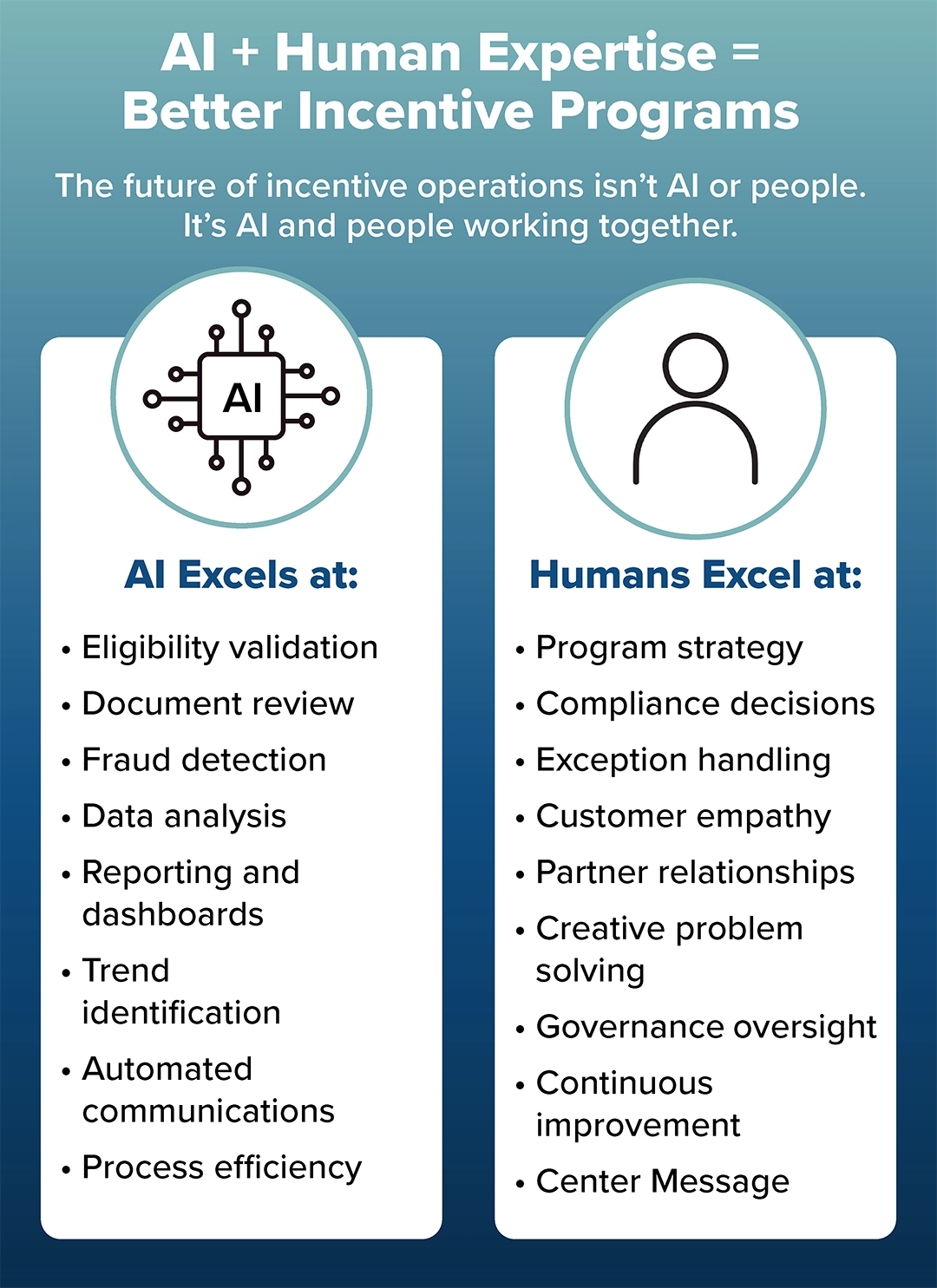 Many organizations assume AI is only valuable for advanced analytics or futuristic use cases. In reality, some of the most impactful applications occur behind the scenes.
Eligibility Validation
One of the most time-consuming aspects of many incentive programs is determining participant eligibility. AI-supported systems can help review submitted documentation, identify missing information, categorize claims, and route exceptions for human review.
This helps reduce administrative workload while improving consistency and processing speed.
Group O's technology ecosystem includes intelligent document processing, AI-enabled integrations, and AI-assisted validation capabilities that support faster program operations.
Importantly, AI should assist validation. Critical decisions should still be subject to appropriate human oversight and quality controls. Looking to understand claims processing? Check out our claims processing page.
Participant Support and Communications
AI can also help improve participant experiences through:
• Automated status updates
• Intelligent routing of inquiries
• Personalized communications
• Faster response times
• Proactive reminders
Participants increasingly expect the same visibility and convenience they experience elsewhere in their digital lives.
Used appropriately, automation can reduce frustration while improving transparency throughout the program journey. This can lead to improved participant experience which in turn improves your brand's reputation.
AI-Assisted Customer Care
AI is also helping customer service teams work more efficiently behind the scenes.
In modern incentive programs, participants often interact with customer care regarding reward status, eligibility questions, documentation requirements, or payment inquiries. AI-enabled tools can assist customer care professionals by summarizing prior account activity, interactions, and case history, helping agents quickly understand a participant's situation and reducing the risk of important details being overlooked.
AI can also support multilingual communication by serving as a translation engine across a broad range of languages, helping organizations provide more accessible service experiences to increasingly diverse participant populations. Additionally, emerging AI-assisted workflows can guide agents through complex interactions by surfacing relevant information, recommended next steps, and program-specific guidance in real time.
The result is not fewer people supporting participants. The result is better-equipped customer service professionals who can resolve questions faster, provide more consistent experiences, and spend more time focusing on the participant rather than searching for information.
Reporting and Analytics
The value of AI extends beyond execution.
It can also help organizations better understand performance.
AI-assisted reporting tools can identify trends, surface anomalies, and highlight opportunities that program managers might otherwise overlook.
For example, AI may help identify:
• Participant segments with unusually high engagement
• Declining redemption rates
• Emerging fraud patterns
• Underperforming offers
• High-performing rewards
• Opportunities for program optimization
These insights can support better business decisions and more efficient use of incentive budgets.
Improving Eligibility, Fraud Detection, and Optimization
As incentive programs become increasingly digital, organizations must balance participant convenience with program integrity.
Smarter Fraud Detection
Fraud detection has traditionally relied on manual review processes.
Today, AI can help identify patterns that deserve additional scrutiny.
Examples may include:
Duplicate submissions
Abnormal redemption behavior
Suspicious account activity
Unusual transaction patterns
Repeated use of identical documentation
AI does not determine guilt.
Instead, it helps identify activity that may warrant investigation.
This creates a more efficient review process while helping protect program integrity.
Group O's incentive technology capabilities include fraud-prevention measures, duplicate checks, validation workflows, and analytics designed to support secure program administration.
Optimization Through Data
One of the greatest opportunities with AI is its ability to analyze large volumes of program data.
Organizations can use AI-assisted insights to evaluate:
• Which rewards generate the strongest engagement
• Which participant groups respond most effectively
• Which communications drive action
• Where friction exists in the process
• When interventions should occur
Rather than waiting until program completion, teams can make adjustments continuously.
The result is a more agile incentive strategy that evolves alongside participant behavior.
Governance and Responsible Use of Automation
As AI capabilities expand, governance becomes increasingly important.
Organizations should establish clear guidelines regarding:
• Data privacy
• Participant consent
• Data security
• Transparency
• Auditability
• Human oversight
• Risk management
Just because an activity can be automated does not necessarily mean it should be.
Organizations must carefully evaluate where automation creates value and where human judgment remains necessary.
This becomes particularly important when programs involve compliance considerations, participant disputes, financial controls, or exception handling.
Responsible AI implementation requires accountability.
Participants should understand how their information is being used and organizations should maintain appropriate safeguards around automated decisions.
The best AI strategies are not built solely around efficiency.
They are built around trust.
Keeping the Human Element Where It Matters
Despite rapid advances in technology, some parts of incentive management remain fundamentally human.
Participants still value:
• Empathy during problem resolution
• Personalized support
• Strategic consultation
• Relationship building
• Program guidance
• Exception management
A participant experiencing an issue with reward eligibility may appreciate automation for status updates, but often wants access to a knowledgeable person when a complex situation occurs.
Similarly, clients may benefit from automated analytics while still relying on experienced program managers to interpret data and recommend future actions.
At Group O, technology and automation are intended to support people, not replace them.
The strongest incentive programs combine:
AI for efficiency. People for judgment. Data for insight. Relationships for long-term success.
Key Terms for This Article
Artificial Intelligence (AI): Technology that enables systems to analyze information, identify patterns, make predictions, and support decision-making.
Intelligent Document Processing (IDP): Technology that helps extract, organize, and process information from submitted documents and forms.
Machine Learning: A subset of AI that allows systems to improve performance and predictions based on data patterns over time.
Anomaly Detection: The identification of unusual activity or behaviors that differ from expected program patterns.
Human-in-the-Loop: An approach that combines automation with human interaction, review and decision-making.
AI Governance: Policies and processes designed to ensure responsible, ethical, and secure use of artificial intelligence.
Predictive Analytics: Analysis techniques that are used to identify likely future outcomes based on historical and current data.
Automated Validation: The use of technology to review eligibility and supporting documentation according to defined business rules.
Data Points & Market Insights
According to research highlighted by the Incentive Research Foundation (IRF), AI is expected to have its greatest impact on data analysis, personalization, administrative efficiency, and content creation, helping incentive professionals spend less time on manual tasks and more time on strategy.
According to the research, 77% of organizations reported they had not yet scaled AI enterprise-wide, highlighting why many companies remain focused on governance, measurement, and responsible implementation before expanding automation.
Research from the Incentive Research Foundation identifies personalization as one of the most promising uses of AI within incentive programs, helping organizations tailor communications, rewards, and participant experiences more effectively. Read more about personalization and first-party data in our April Mile - Mile 4.
The Incentive Research Foundation notes that AI has the potential to improve operational efficiency by assisting with administrative tasks, data analysis, reporting, and content development, allowing incentive professionals to spend more time on strategic program management.
What's Next in November: Inclusive, Accessible & Sustainable Incentives
As organizations continue modernizing incentive programs, technology alone is not enough. Programs must also be designed to serve diverse participant populations responsibly and effectively.
In November, we'll explore Inclusive, Accessible & Sustainable Incentives, including:
• Designing programs that are equitable and accessible
• Sustainability considerations in incentive strategy
• Responsible handling of unused rewards
• Balancing participant choice with business goals
• Building trust through transparency and inclusion
The most successful incentive programs of the future won't simply be the most innovative. They'll be the ones that ensure every participant can engage, participate, and benefit from the experience.
Here is one final thought, and it should be top of mind when considering the role of AI in your incentive program: AI has the potential to transform incentive operations, but it is not a strategy by itself. Organizations that succeed will be those that combine automation with governance, analytics with accountability, and technology with human expertise. The future of incentives is not AI versus people. It is AI and people working together to create smarter, safer, and more effective programs.
 About the Author
Paul Flemr is Senior Vice President of Incentive Marketing Solutions at Group O, bringing more than 17 years of leadership experience across operations, customer care, and incentive marketing. Throughout his career at Group O, Paul has held progressive roles spanning Customer Care, Operations, and Executive Leadership, giving him a uniquely end‑to‑end perspective on building and delivering high‑impact incentive programs. Known for his passion for concierge‑level client service, Paul is deeply committed to ensuring incentive marketing clients receive seamless, white‑glove support—from strategy and program design through execution and fulfillment. He is a strong advocate for embracing new technology and innovative ideas to continuously elevate program performance and the client experience. As an author for The 2026 Incentive Strategy Roadmap, Paul brings practical insight, operational expertise, and a forward‑looking mindset to help organizations design incentive programs that drive engagement, loyalty, and measurable results.
